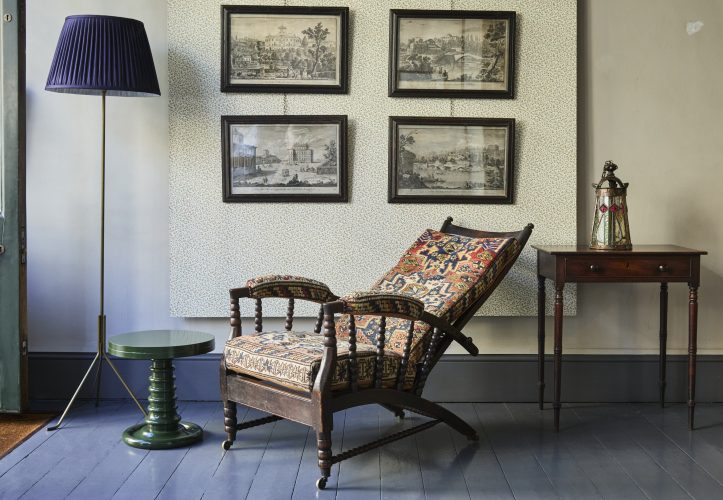
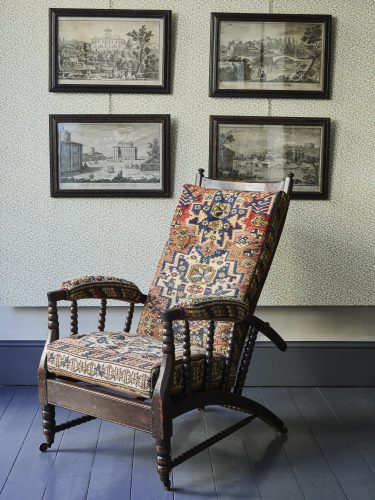
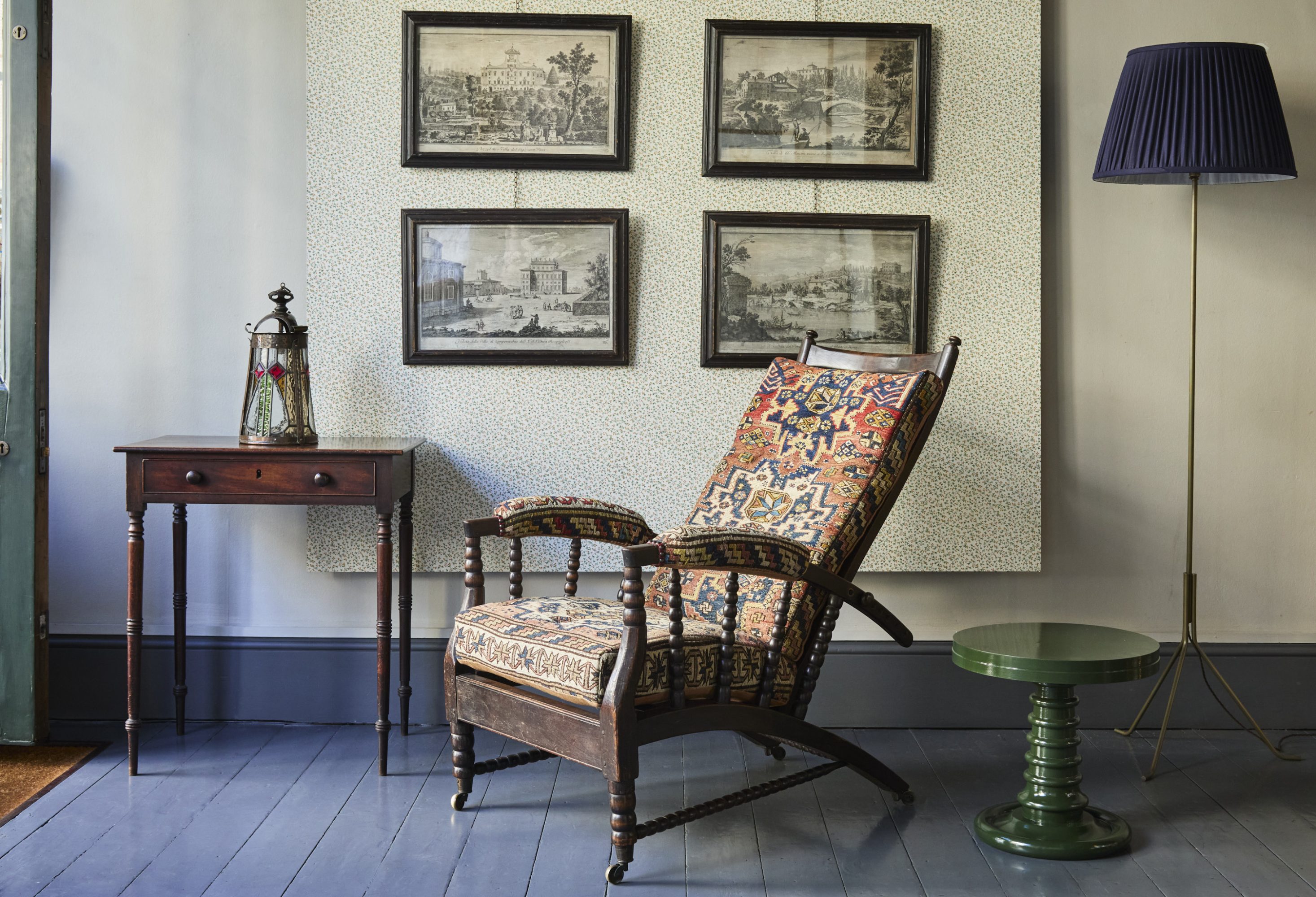
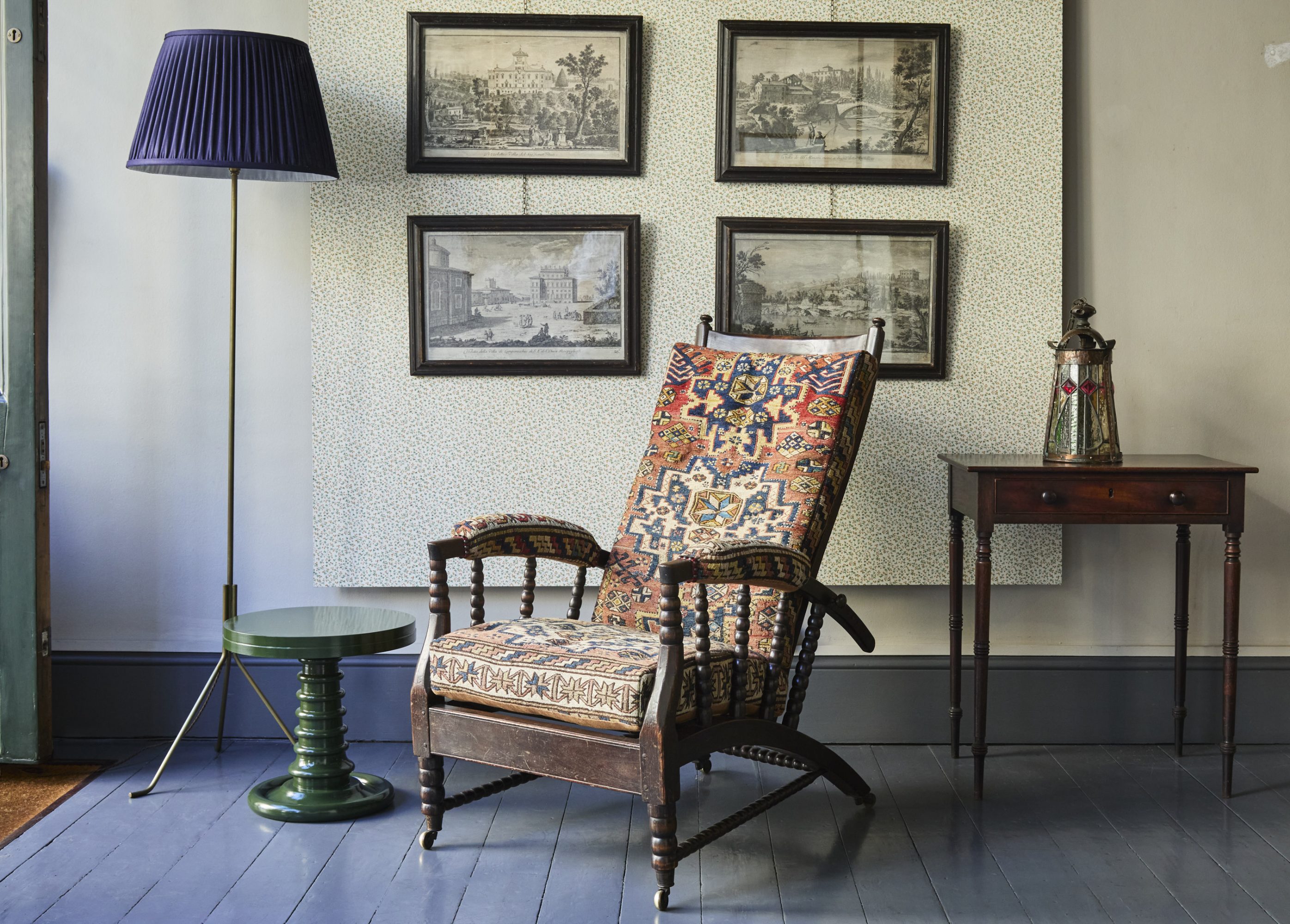
A Very Rare Early Victorian Adjustable Reclining Armchair, Later Adapted By Philip Webb For Morris, Marshall, Faulkner & Co.
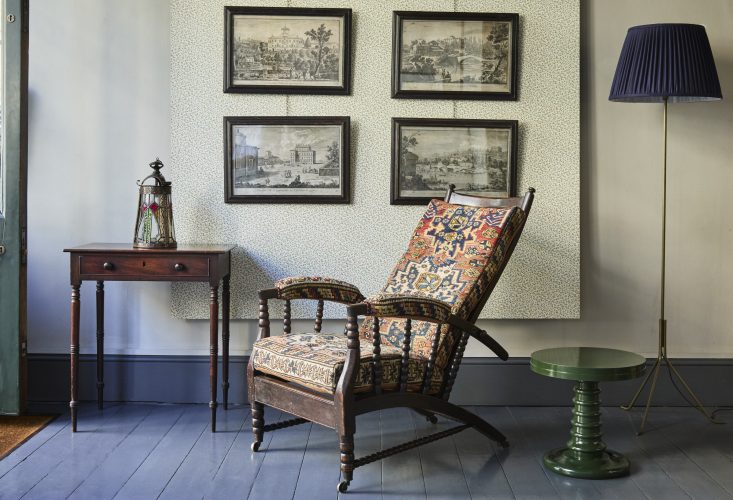
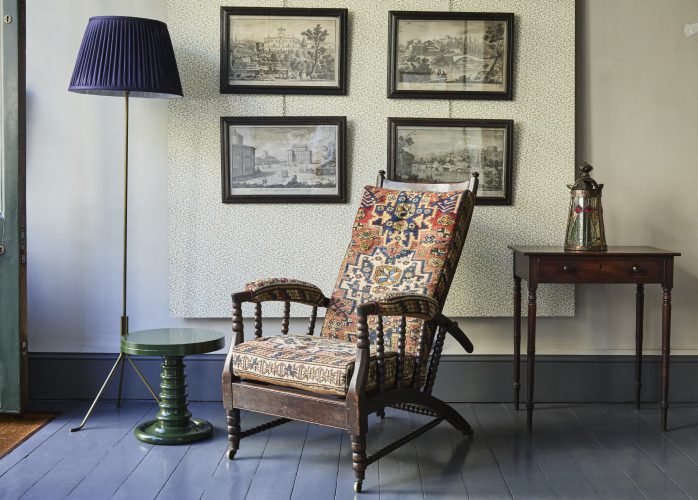
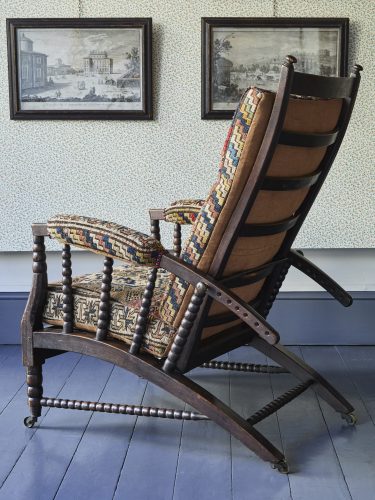
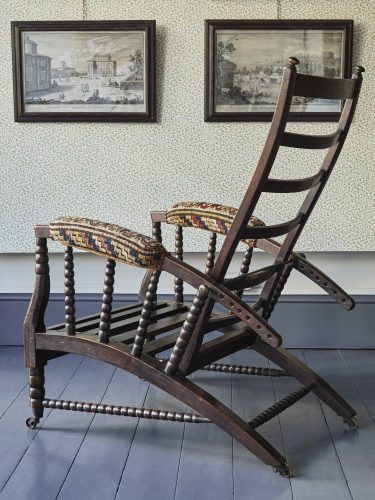
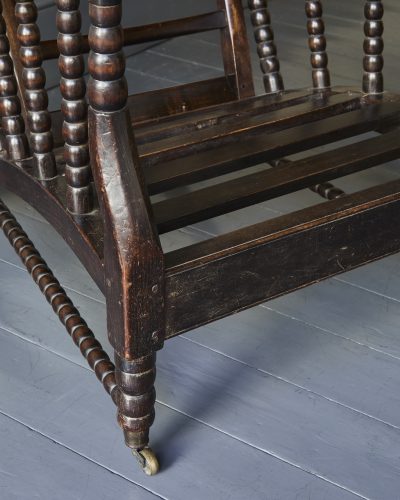
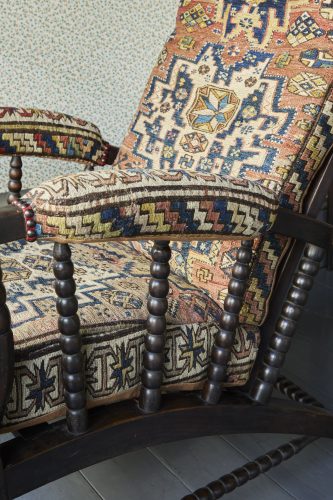
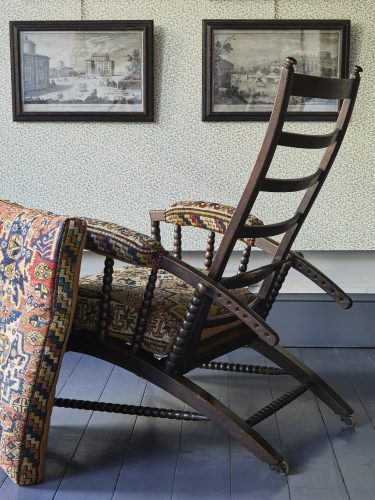
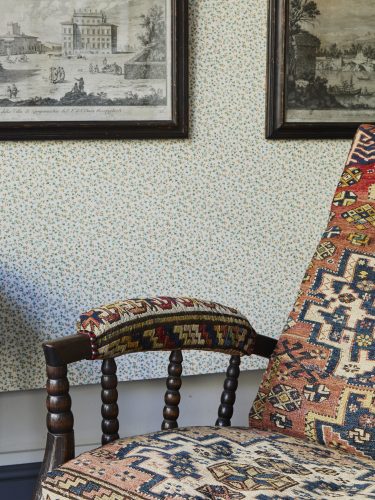
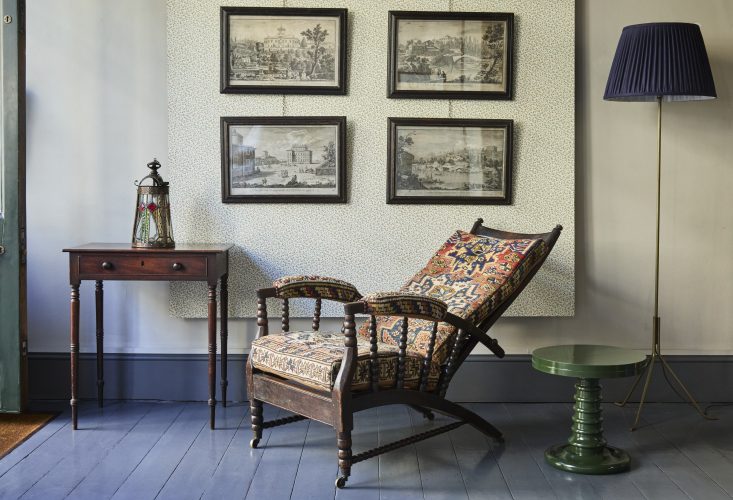
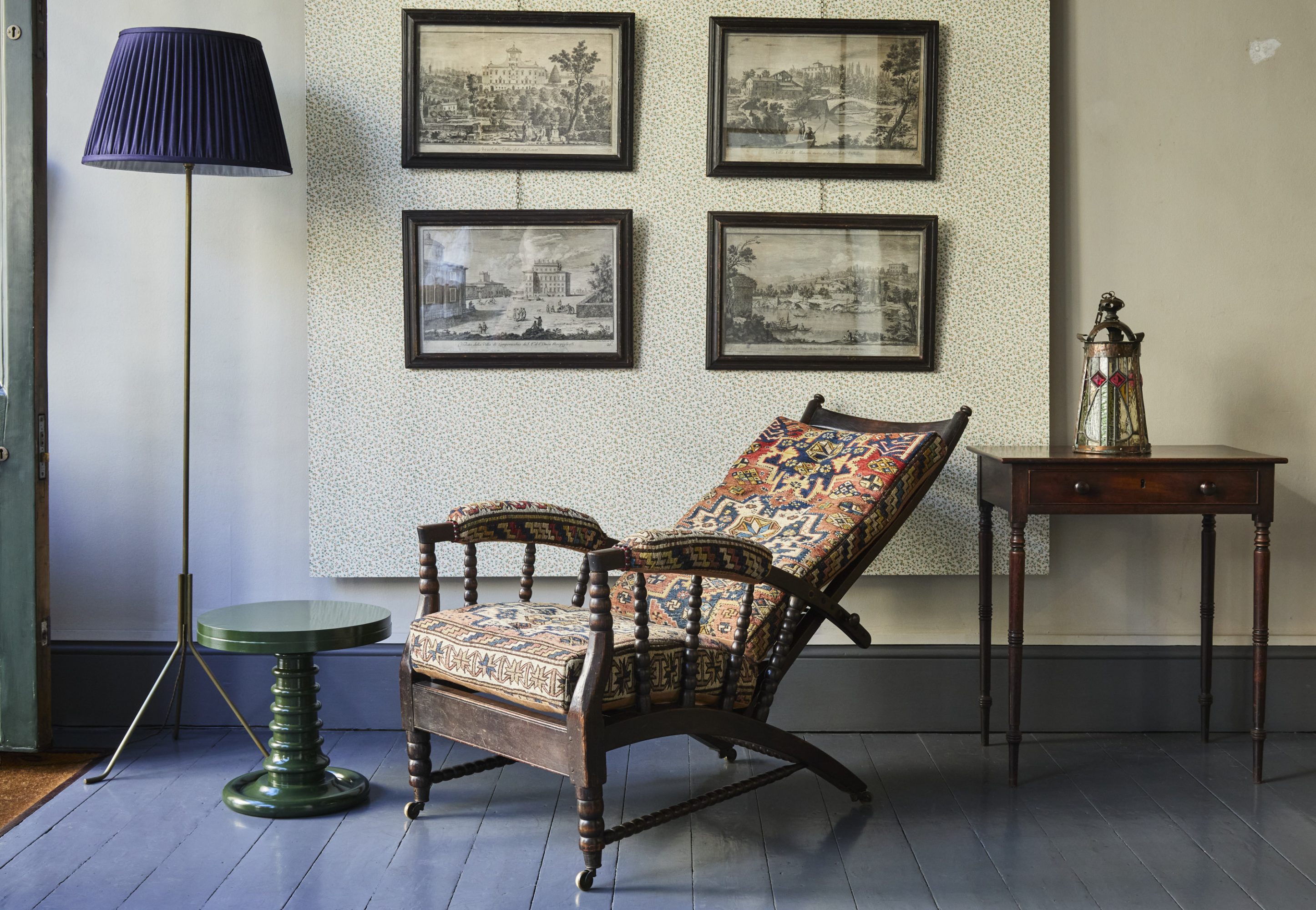
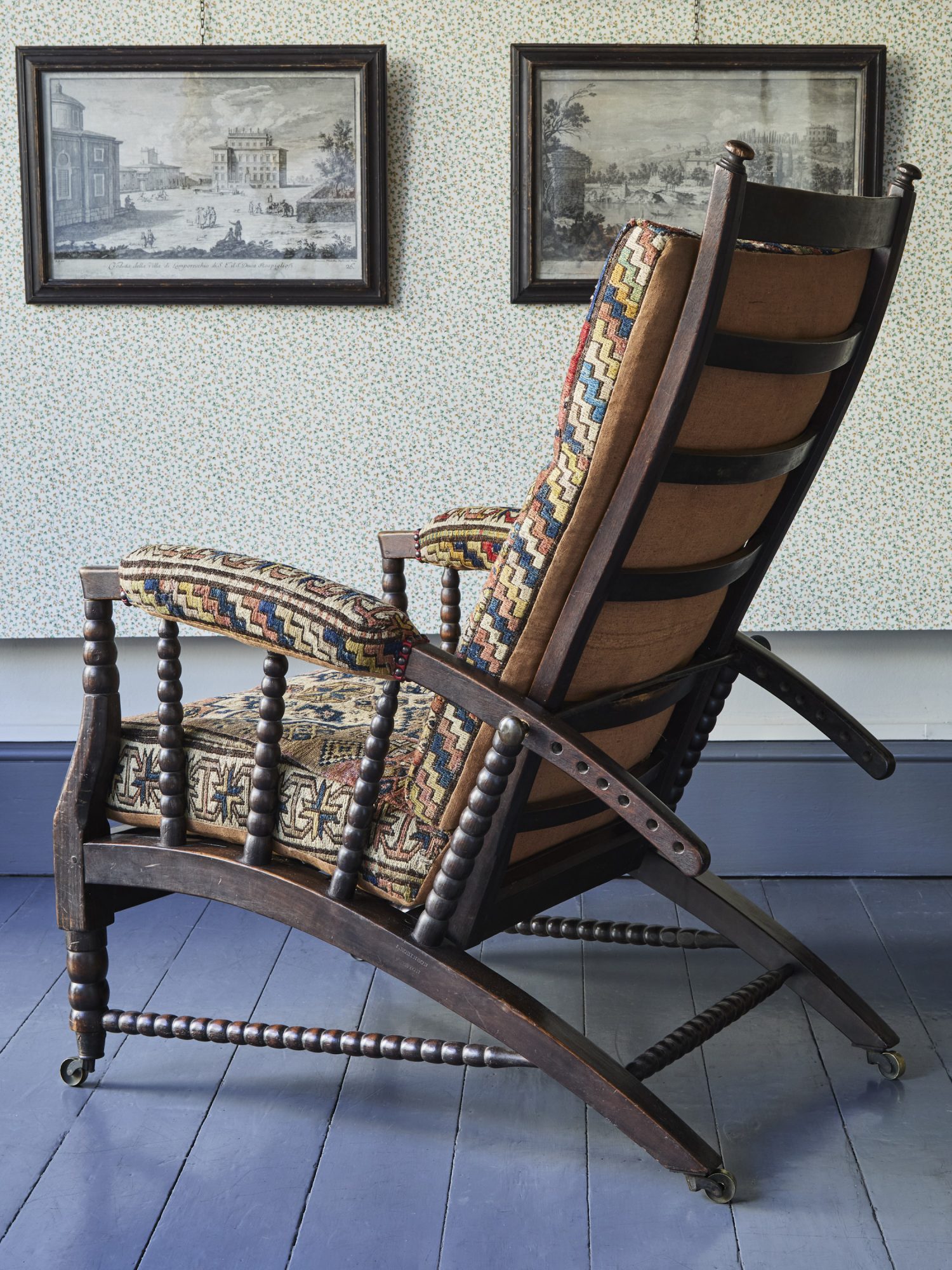
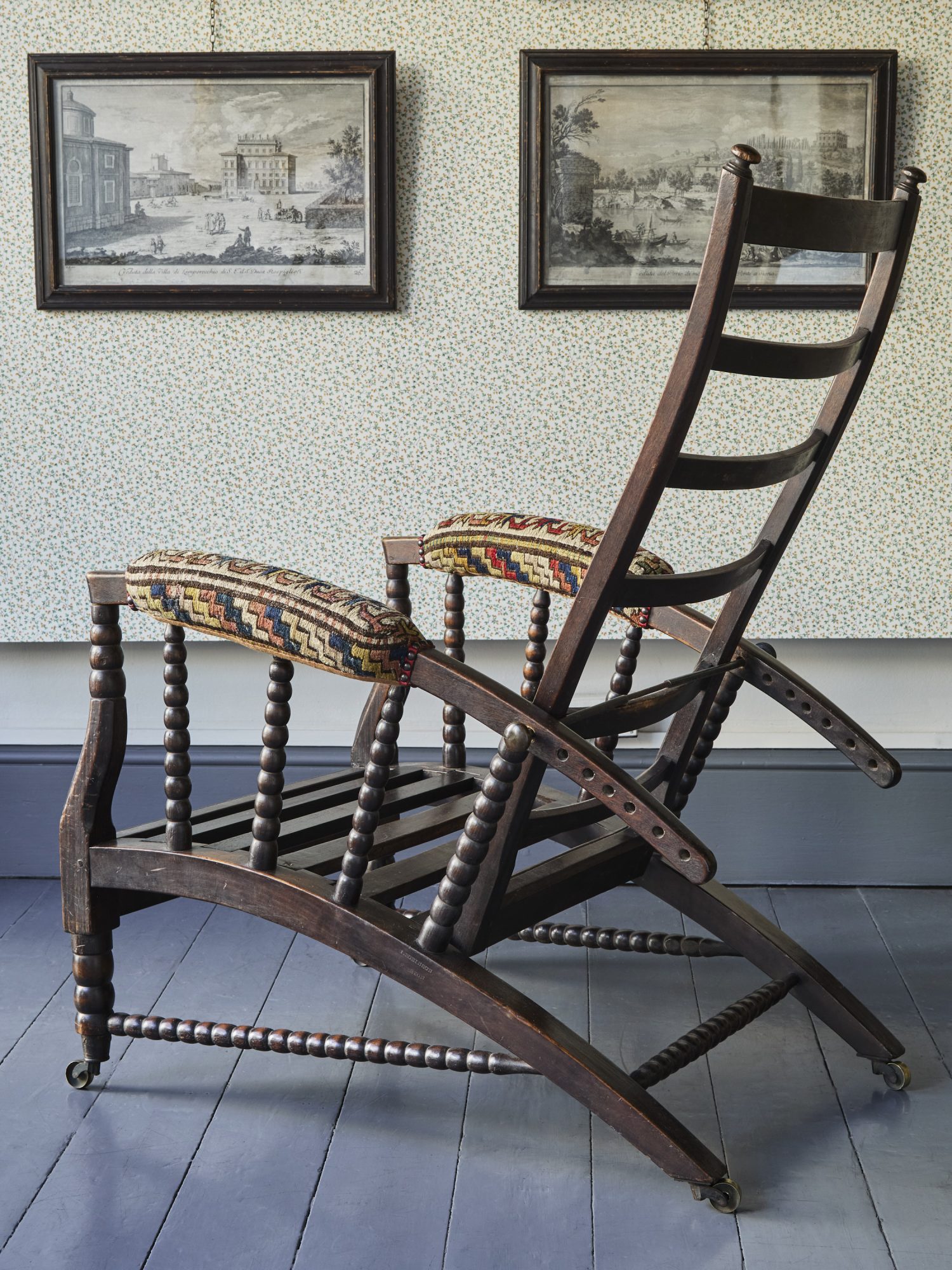
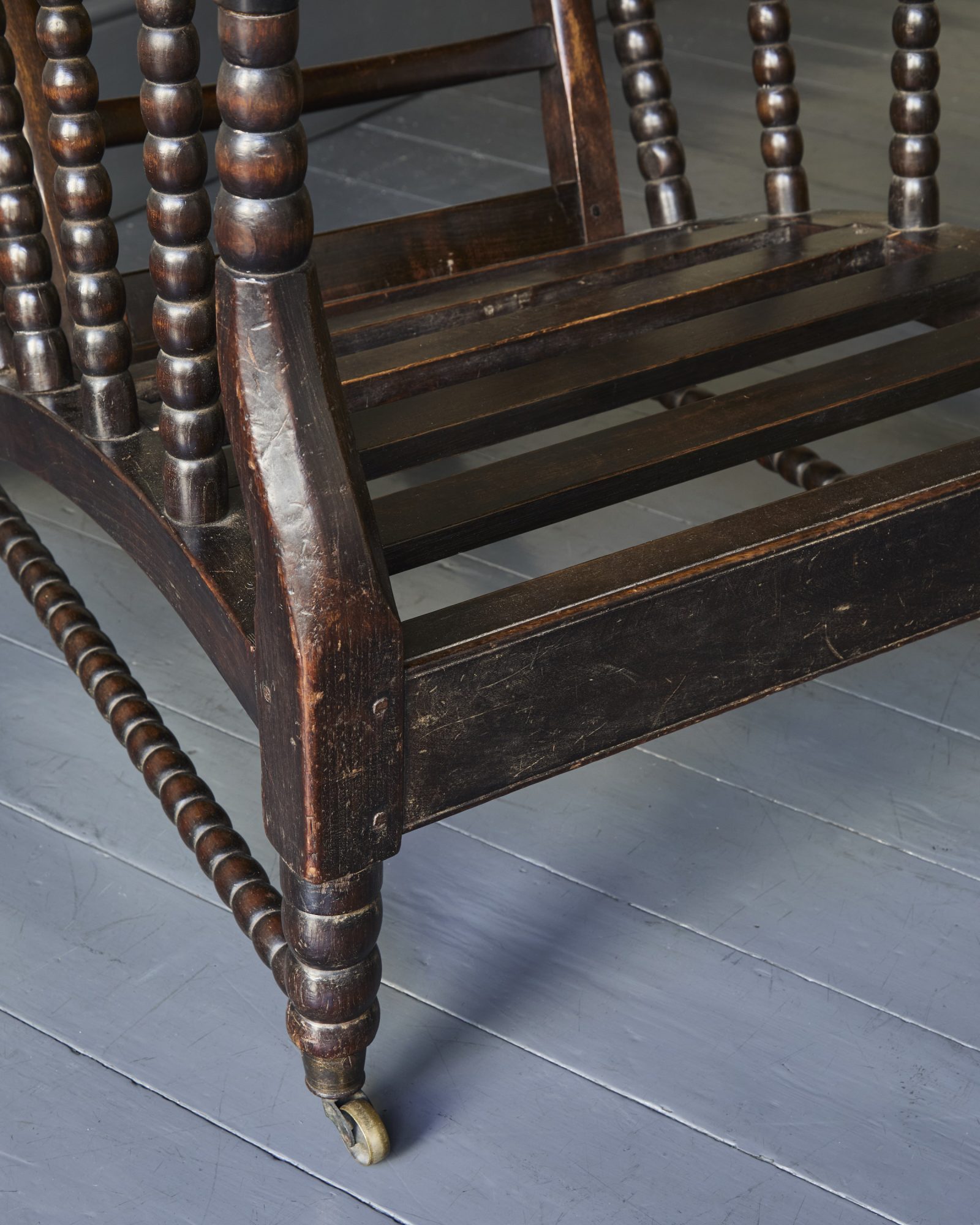
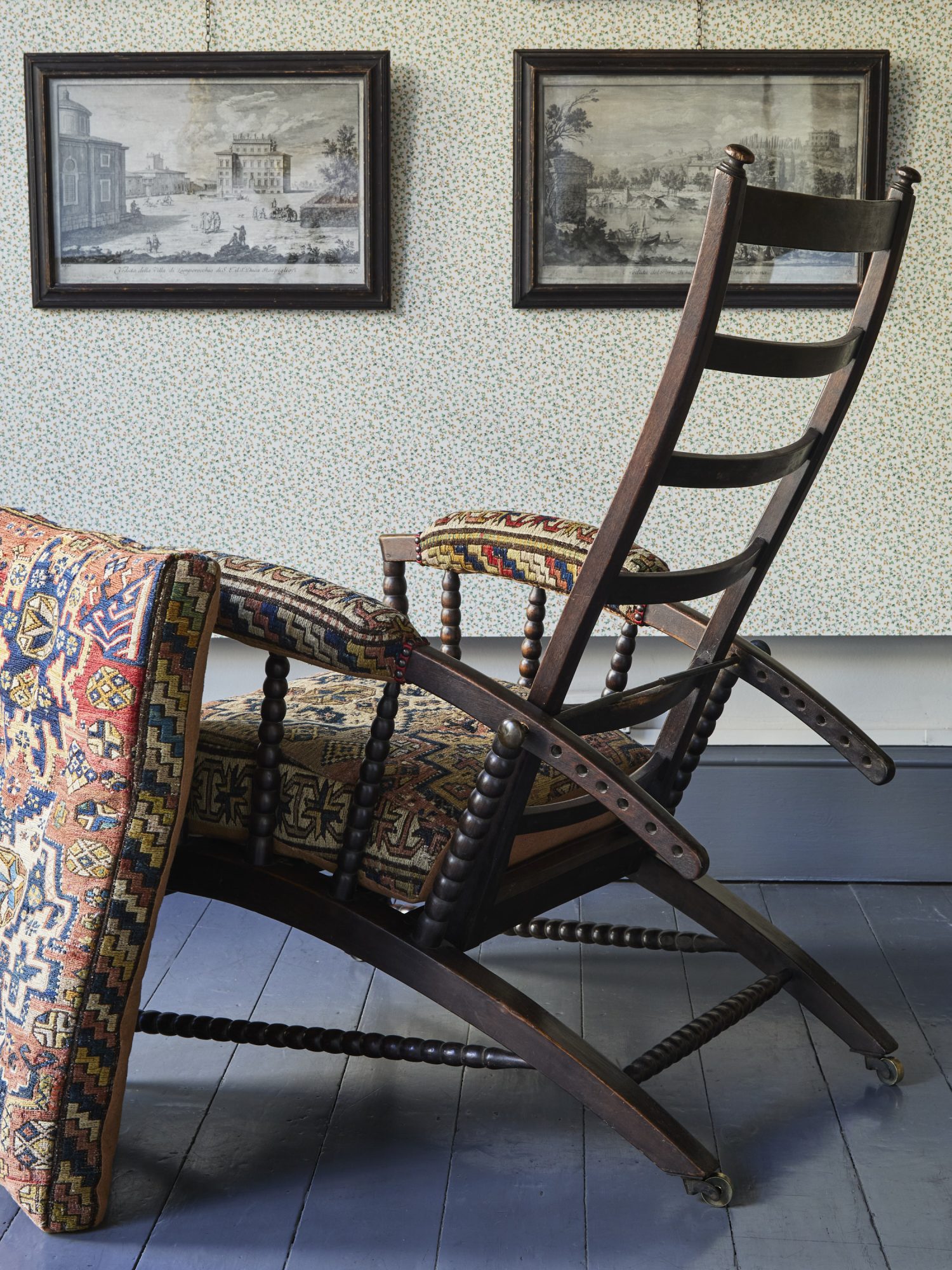
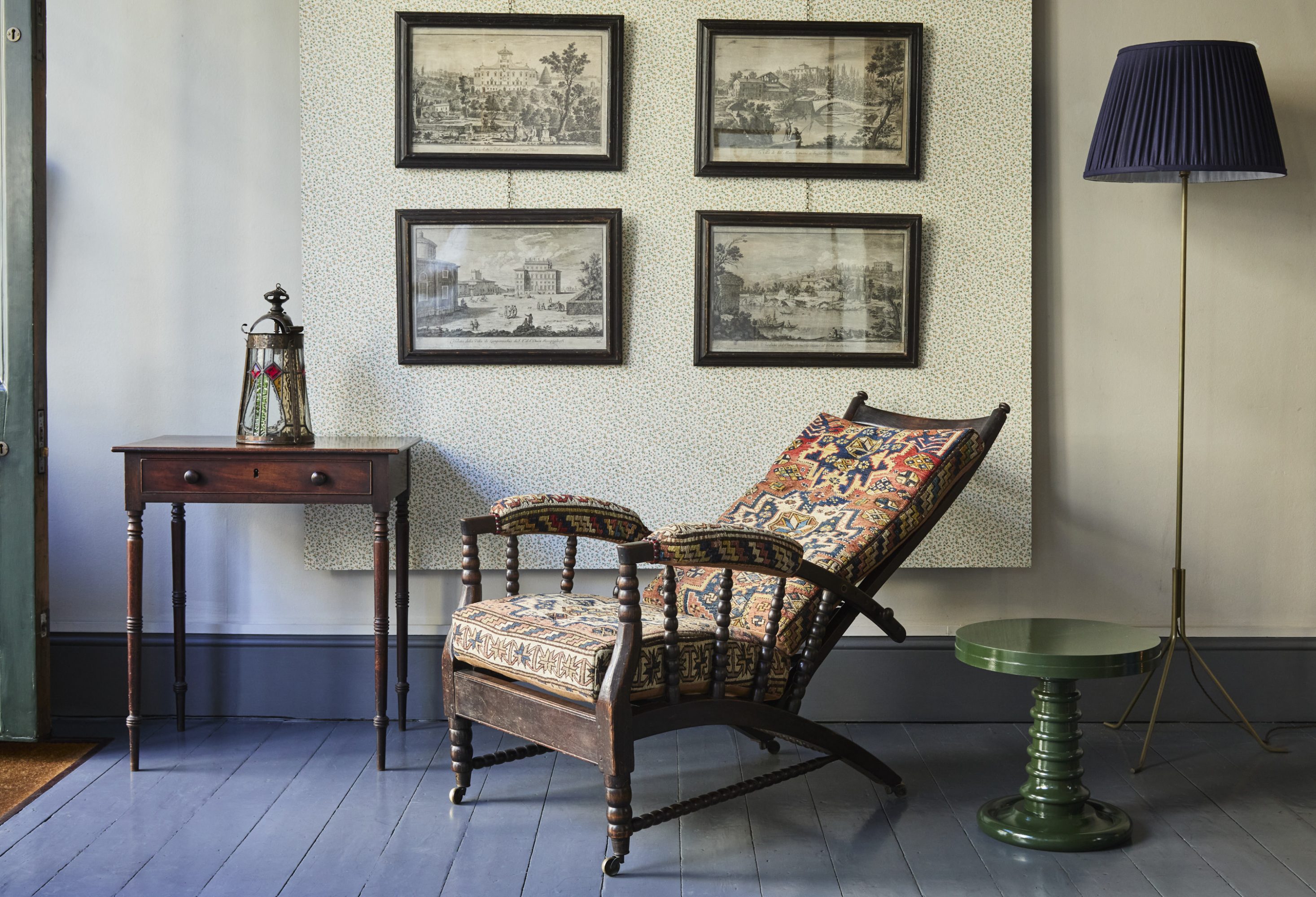
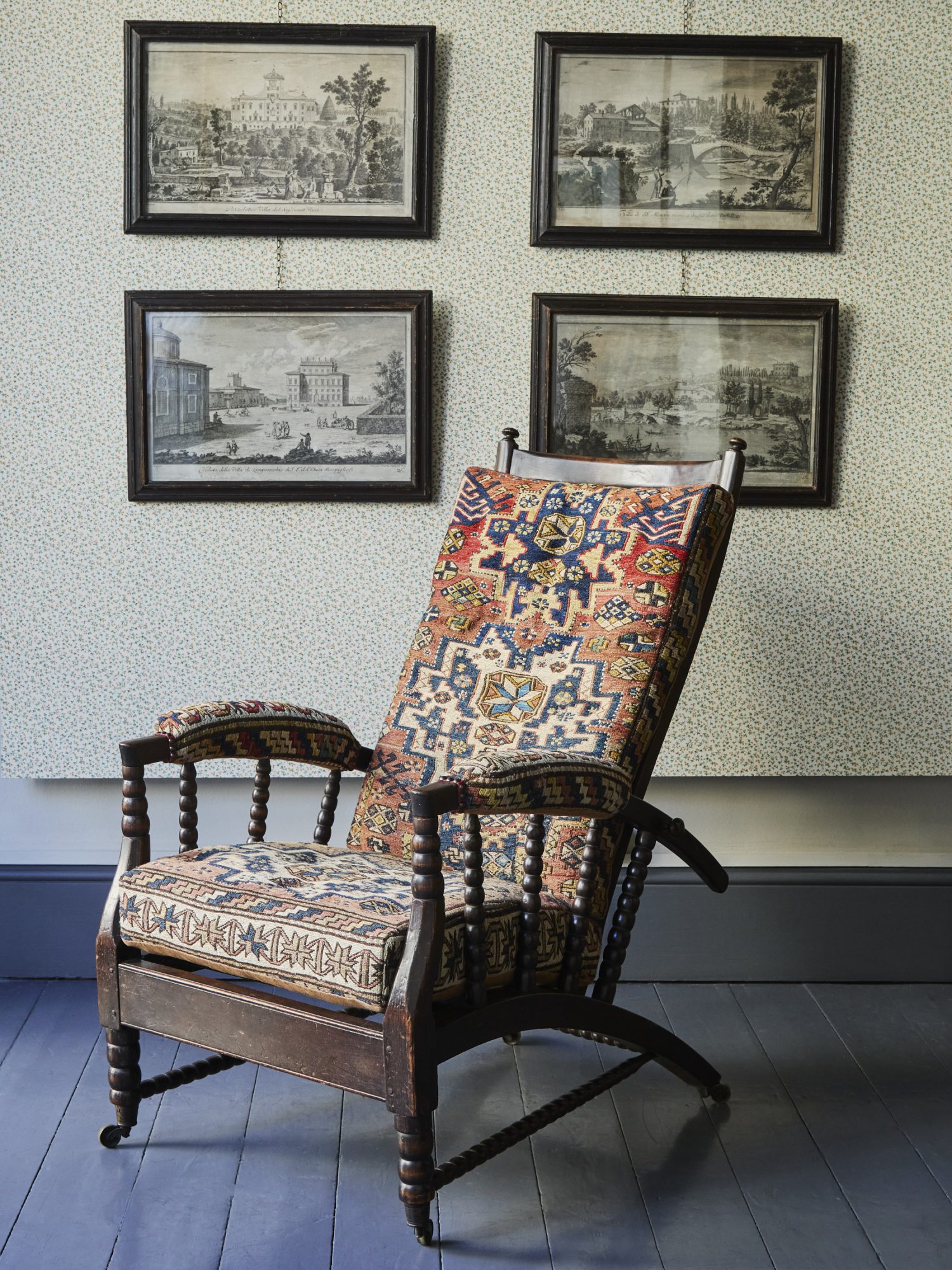
A very rare early Victorian reclining armchair in stained beech, the bobbin turned frame with a tall ladder back adjustable from upright to an almost fully reclined position by means of a metal rod locating into a series of holes in the projecting rear arm extensions. The distinctive down curved arms sweep backwards into long arched side rails with multiple bobbin turned supports, above a loose seat squab resting on horizontal wooden slats. The lower rails continue backwards and downwards to form the rear supports, with turned stretchers and brass castors.
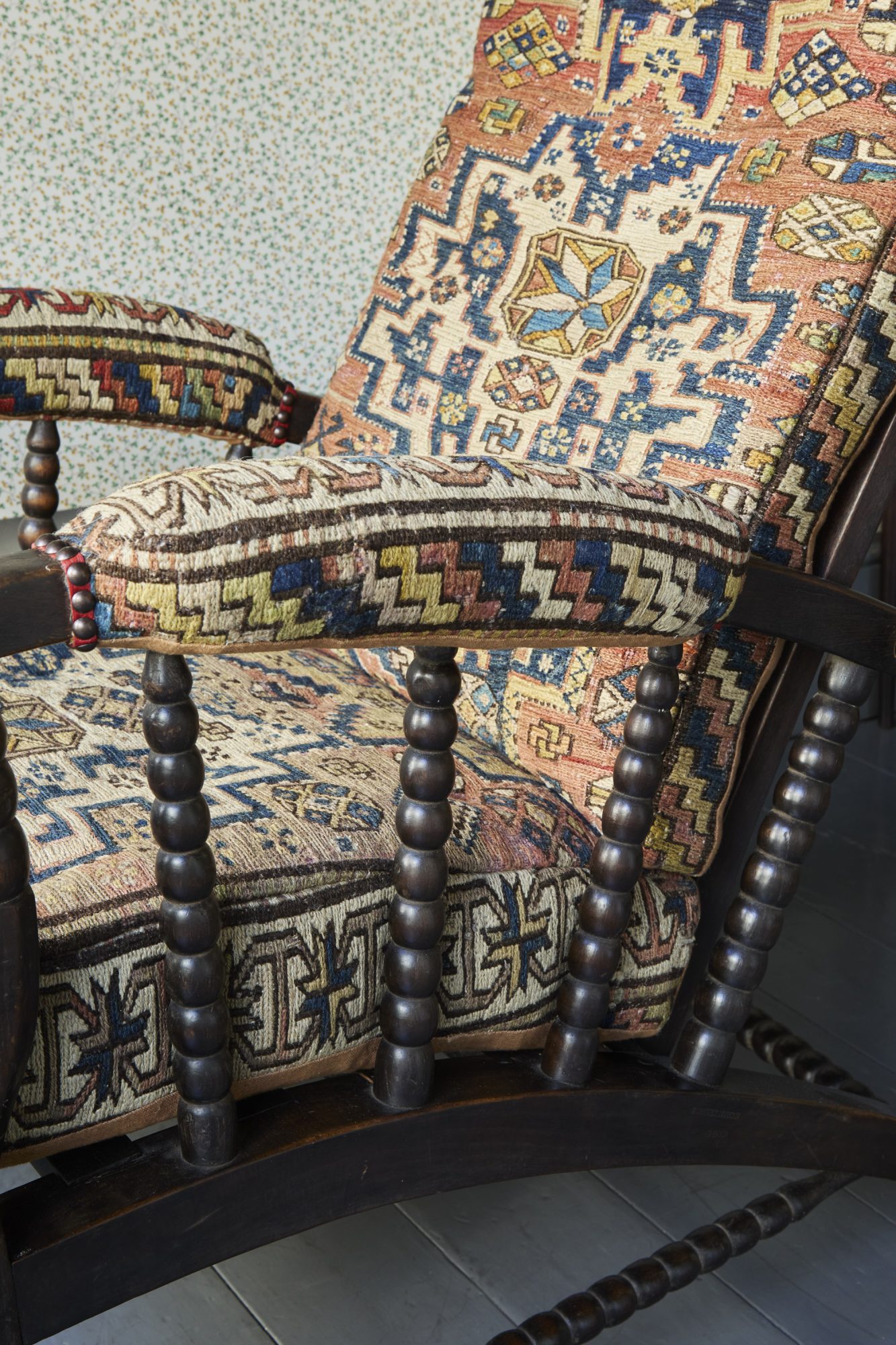
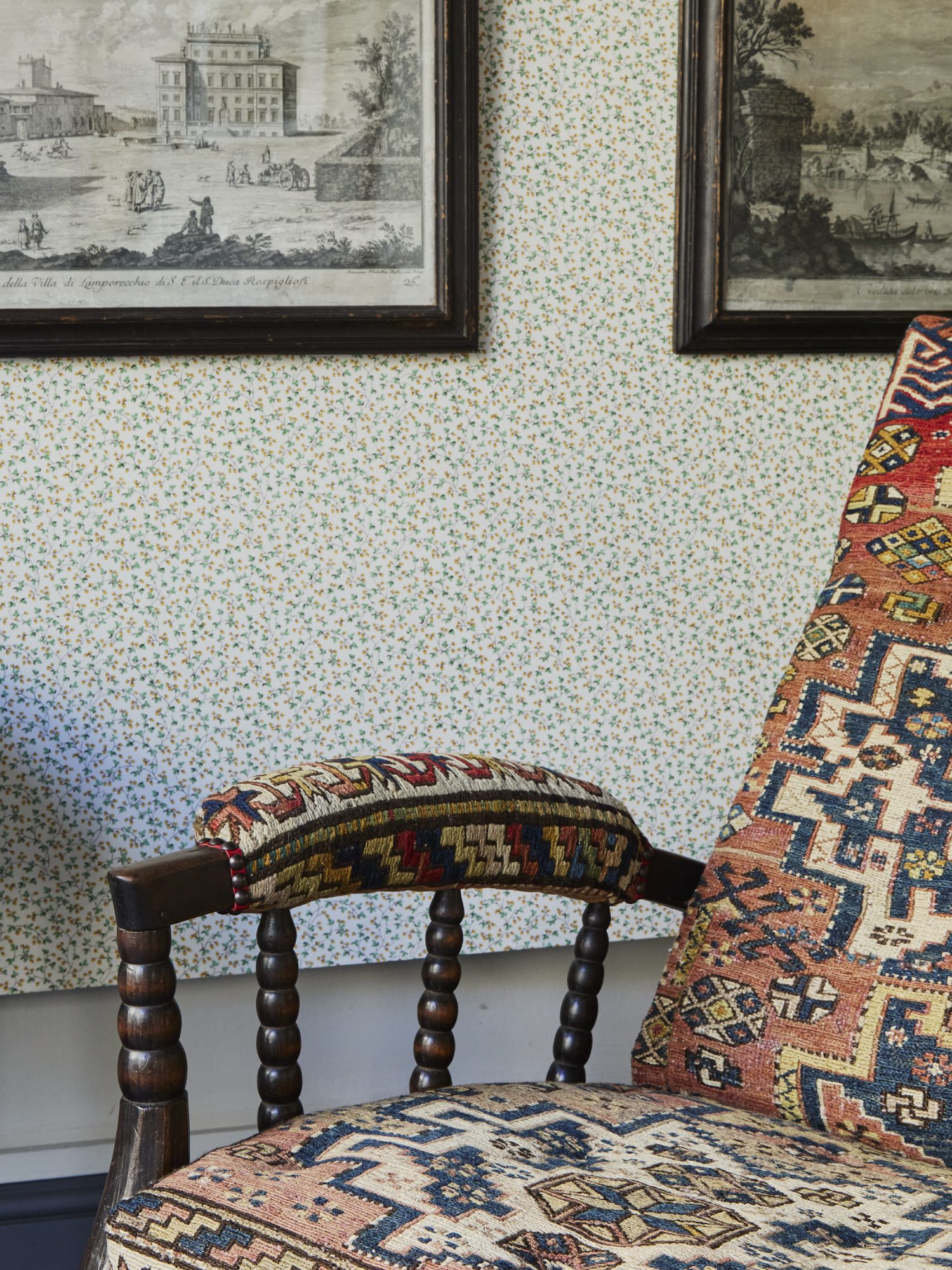
Stamped to the outer side rail in two lines J. ROBINSON, PRESTON. The back and seat cushions and arms have been sensitively reupholstered using natural materials and traditional techniques, and covered with antique carpet fragments of richly coloured geometric design. English, circa 1845.
This remarkable chair is of particular interest for its apparent relationship to the celebrated adjustable armchair later developed by Philip Webb for Morris, Marshall, Faulkner & Co. in the 1860s. John Robinson is documented as a chair and bedstead maker working in Preston between 1816 and 1848. A chair attributed to Robinson and published by Dr B. D. Cotton bears a closely comparable I. ROBINSON / PRESTON stamp, the use of I for J reflecting a longstanding typographical convention.
If the stamp on the present chair is indeed that of John Robinson of Preston, its manufacture would pre-date Webb’s adaptation by some two decades or more. Around 1866, Warington Taylor, business manager of Morris, Marshall, Faulkner & Co., encountered an adjustable chair in the workshop of the Herstmonceux carpenter Ephraim Colman and sent a sketch to Webb, who subsequently developed the form for the Firm. The William Morris Gallery has also noted evidence for a closely related design in an early nineteenth-century catalogue.
The present chair may therefore represent a rare survival from the earlier British tradition of adjustable chairs from which the Webb/Morris model ultimately developed. Its similarities include the tall adjustable ladder back, pierced projecting rails controlling the degree of recline, exposed seat bars supporting a loose cushion, extensive turned construction and, most distinctively, the long curving side members sweeping towards the rear castors.
No documentary evidence presently establishes a direct connection between Robinson, Colman and Webb. Nevertheless, the chair provides intriguing material evidence for an earlier regional tradition of adjustable reclining furniture and may represent an important precursor to the form later popularly known as the “Morris chair”.
Literature
Another Piece in the Jigsaw, John Robinson, Preston 2001. Dr. B.D.Cotton: Windsor Armchairs with Cabriole Weaving Seating: Caners, Matters & Willow Workers https://regionalfurnituresociety.org/wp-content/uploads/2022/01/rfs-nl-34-cotton.pdf
J. Boram, ‘A Regional Perspective on the Innovative Development of Light Chairs’, Regional Furniture, XXVI, 2012, particularly figs. 23–26; fig. 24 illustrating a chair stamped I. ROBINSON PRESTON. The Robinson attribution and reference are recorded by BIFMO.
https://regionalfurnituresociety.org/wp-content/uploads/2013/02/a05-boram.pdf
Dimensions
Max Width 700mm / 27½"Max Height 1060mm / 41¾"
Max Depth 840mm / 33"